|
|
|
|
|
 |
|
|
|
|
|
|
|
|
|
No.610 Sqn RAF Founded : 10th February 1936
County of Chester (Auxiliary) Alifero tollitur axe ceres - Ceres rising in a winged car 610 squadron was formed AT Hooton Park, Wirral in Cheshire on 10 February 1936 as one of the Auxiliary Air Force squadrons equipped with the light bomber the Hawker Hart. In May 1938 610 Squadron aircraft were upgraded to the new Hawker Hind. On 1 January 1939 the squadron role was changed into that of a fighter squadron, and on the outbreak of war in September 1939, he Squadron began receiving the new Hawker Hurricane. By the end of that same month it was flying the Supermarine Spitfire. During the Battle of Britain 610 Squadron was attached to No. 3 Group and was initially based at RAF Gravesend but moved to Biggin Hill before the German offensive began and was one of the units bearing the brunt of German attacks. It moved to RAF Acklington for the rest and recuperation at the end of August, having sustained severe casualties. During the Battle of Britain the squadron included Pilot Officer, later Squadron Leader, Constantine Pegge. In 1941, the squadron moved south to RAF Tangmere where it became part of the Tangmere wing, a three squadron wing under the command of Douglas Bader. 610 Squadron remained based in the UK until 1945, when it moved to the continent to provide fighter cover as the allies entered Germany. 610 Squadron was disbanded before the end of the war at RAF Warmwell in March 1945. |
No.610 Sqn RAF
  The Battle for the Skies Over Dieppe, 19th August 1942 by Graeme Lothian. (PC) |   Tribute to Pilot Officer Pegge of No.610 Squadron by Ivan Berryman. (PC) |   Return of the Heroes by Ivan Berryman. (PC) |   Tribute to No.610 Sqn by Ivan Berryman. (PC) |
No.610 Sqn RAF Artwork Collection |
  Close Encounter by Ivan Berryman. |   P.O. Constantine Pegge, 610 Sqn, August 1940 by Graeme Lothian. (P) |   Time to Leave by Ivan Berryman. |
  A Dunkirk Encounter by Ivan Berryman. |   Kerr's Last Combat by Ivan Berryman. |   Clipped Signature - Johnnie Johnson. |
 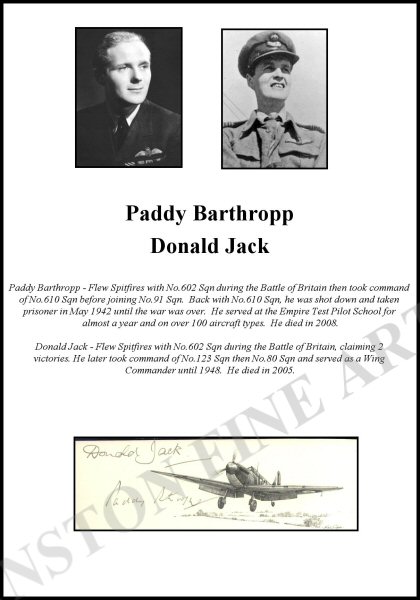 Clipped Signature - Paddy Barthropp. |   Clipped Signature - Cyril Bamberger. |   Clipped Signature - Robert Beardsley. |
  Clipped Signature - Norman Samuels. |   Clipped Signature - Herbert Rigby. |   The Battle for the Skies Over Dieppe, 19th August 1942 by Graeme Lothian. |
  Return of the Heroes by Ivan Berryman. |   Close Call by Robert Taylor. |   The Battle for Britain by Robert Taylor. |
  Coastal Patrol by Richard Taylor. |   Their Finest Hour by Nicolas Trudgian. |   Top Cover by Robert Taylor. |
  Tribute to No.610 Sqn by Ivan Berryman. |   Escorting Blenheims to Le Trait - Spitfire W3455 of No.610 Squadron by Ivan Berryman. (P) |   Tribute to Flight Lieutenant Warner of No.610 Sqn by Ivan Berryman. (P) |
  Tribute to Pilot Officer Pegge of No.610 Squadron by Ivan Berryman. |   Chariots of Fire by Gerald Coulson. |
| Aces for : No.610 Sqn RAF | ||
| A list of all Aces from our database who are known to have flown with this squadron. A profile page is available by clicking the pilots name. | ||
| Name | Victories | Info |
| James E Johnnie Johnson | 36.91 | The signature of James E Johnnie Johnson features on some of our artwork - click here to see what is available. |
| Tony Gaze | 12.50 | The signature of Tony Gaze features on some of our artwork - click here to see what is available. |
| Hugh Spencer Leslie Dundas | 11.00 | The signature of Hugh Spencer Leslie Dundas features on some of our artwork - click here to see what is available. |
| Dennis Crowley-Milling | 8.00 | The signature of Dennis Crowley-Milling features on some of our artwork - click here to see what is available. |
| No.610 Sqn RAF Aircraft details |
 Hurricane Manufacturer : Hawker Built : 14533 | Hurricane Royal Air Force Fighter, the Hawker Hurricane had a top speed of 320mph, at 18,200 feet and 340mph at 17,500, ceiling of 34,200 and a range of 935 miles. The Hurricane was armed with eight fixed wing mounted .303 browning machine guns in the Mark I and twelve .303 browning's in the MKIIB in the Hurricane MKIIC it had four 20mm cannon. All time classic fighter the Hurricane was designed in 1933-1934, the first prototype flew in June 1936 and a contract for 600 for the Royal Air Force was placed. The first production model flew ion the 12th October 1937 and 111 squadron of the Royal Air Force received the first Hurricanes in January 1938. By the outbreak of World war two the Royal Air Force had 18 operational squadrons of Hurricanes. During the Battle of Britain a total of 1715 Hurricanes took part, (which was more than the rest of the aircraft of the Royal air force put together) and almost 75% of the Victories during the Battle of Britain went to hurricane pilots. The Hawker Hurricane was used in all theatres during World war two, and in many roles. in total 14,533 Hurricanes were built. |
 Spitfire Manufacturer : Supermarine Built : 20351 | Spitfire Royal Air Force fighter aircraft, maximum speed for mark I Supermarine Spitfire, 362mph up to The Seafire 47 with a top speed of 452mph. maximum ceiling for Mk I 34,000feet up to 44,500 for the mark XIV. Maximum range for MK I 575 miles . up to 1475 miles for the Seafire 47. Armament for the various Marks of Spitfire. for MK I, and II . eight fixed .303 browning Machine guns, for MKs V-IX and XVI two 20mm Hispano cannons and four .303 browning machine guns. and on later Marks, six to eight Rockets under the wings or a maximum bomb load of 1,000 lbs. Designed by R J Mitchell, The proto type Spitfire first flew on the 5th March 1936. and entered service with the Royal Air Force in August 1938, with 19 squadron based and RAF Duxford. by the outbreak of World war two, there were twelve squadrons with a total of 187 spitfires, with another 83 in store. Between 1939 and 1945, a large variety of modifications and developments produced a variety of MK,s from I to XVI. The mark II came into service in late 1940, and in March 1941, the Mk,V came into service. To counter the Improvements in fighters of the Luftwaffe especially the FW190, the MK,XII was introduced with its Griffin engine. The Fleet Air Arm used the Mk,I and II and were named Seafires. By the end of production in 1948 a total of 20,351 spitfires had been made and 2408 Seafires. The most produced variant was the Spitfire Mark V, with a total of 6479 spitfires produced. The Royal Air Force kept Spitfires in front line use until April 1954. |
| No.610 Sqn RAF Pilot and aircrew signature details |
|
Contact Details |
|
Sign Up To Our Newsletter!
This website is owned by Cranston Fine Arts. Torwood House, Torwoodhill Road, Rhu, Helensburgh, Scotland, G848LE Contact: Tel: (+44) (0) 1436 820269. Email: cranstonorders -at- outlook.com
|
|
|


