|
|
|
|
|
 |
|
|
|
|
|
|
|
|
|
No.609 Sqn RAF Founded : 10th February 1936
West Riding (Auxiliary) Tally ho! 609 (West Riding) Squadron Royal Auxiliary Air Force: 609 Squadron came into being on the 10th February 1936 as part of the expanding Auxiliary Air Force. Initially a bomber squadron equipped with Hawker Harts. On 8th December, 1938, the Squadrons role was changed from bomber to fighter and the squadron took delivery of its first Spitfires Mk I during August 1939. The squadrons first victory was a Heinkel HE111 H-2 of 2/KG26 which was shot down near St. Abbs Head, 27th February 1940, by Flying Officer G. D. Ayre, Pilot Officer J R Buchanan and Flying Officer D Persse-Joynt. 609 squadron was, it is said, the first Spitfire Squadron to reach 100 victories (Ju88 A-5 1/KG51) on 21st October 1940. The victory was shared by Flight Lieutenant F J Howell and Pilot Officer S J Hill. During April 1942, 609 began to replace its Spitfires with Hawker Typhoons, and went on to become the first Typhoon squadron with 227 victories. Based at many RAF Stations 609 was in action throughout WWII, covering the Dunkirk evacuation, the Battle of Britain and supporting the D-Day landings as part of the 2nd TAF. There were many decorations awarded to squadron members, these included 3 DSOs, 22 DFCs and Bars and 4 DFMs. On 16th December 1947, King George VI gave permission for use of the Royal Prefix for all Auxiliary Air Force Squadrons. 609 Squadron Royal Auxiliary Air Force was disbanded on 10th March 1957, whilst equipped with Gloster Meteors F8 at RAF Church Fenton, Yorkshire. On 1st October, 1999, 609 (west Riding) Squadron, Royal Auxiliary Air Force, was re-formed at RAF Leeming operating in the guise of Air Defence Support Squadron (ADSS). |
No.609 Sqn RAF
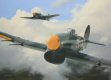  Typhoon! by Ivan Berryman. (PC) |   Red Section Scramble by Ivan Berryman. (PC) |   A Busy Day at the Office by Ivan Berryman. (PC) |   Hard Hitter by Ivan Berryman. (PC) |
No.609 Sqn RAF Artwork Collection |
  Vickers Supermarine Spitfire Mk Ia X4590 PR-F. by M A Kinnear. |   Typhoon Attack by Robert Taylor. |   F/Lt J R Baldwin by Ivan Berryman. |
  Hard Hitter by Ivan Berryman. |   Red Section Scramble by Ivan Berryman. |   Clipped Signature - John Bisdee. |
  Clipped Signature - Ron Grant. |   Clipped Signature - Raymond A Lallemant. |   Spitfire Tally-Ho by Geoff Lea. |
  Spitfires Over the Needles by Philip West. |   Typhoon! by Ivan Berryman. |   A Busy Day at the Office by Ivan Berryman. |
  Supermarine Spitfire MkI by Philip West. |   Supermarine Spitfire Mk 1a by Keith Woodcock. |   Southern Patrol by Philip West. |
  Into the Blue by Simon Atack. |   Typhoon Scramble by Stephen Brown. |   Top Cover by Philip West. |
| Aces for : No.609 Sqn RAF | ||
| A list of all Aces from our database who are known to have flown with this squadron. A profile page is available by clicking the pilots name. | ||
| Name | Victories | Info |
| J R Baldwin | 15.00 | |
| John Bisdee | 8.00 | The signature of John Bisdee features on some of our artwork - click here to see what is available. |
| No.609 Sqn RAF Aircraft details |
 Hurricane Manufacturer : Hawker Built : 14533 | Hurricane Royal Air Force Fighter, the Hawker Hurricane had a top speed of 320mph, at 18,200 feet and 340mph at 17,500, ceiling of 34,200 and a range of 935 miles. The Hurricane was armed with eight fixed wing mounted .303 browning machine guns in the Mark I and twelve .303 browning's in the MKIIB in the Hurricane MKIIC it had four 20mm cannon. All time classic fighter the Hurricane was designed in 1933-1934, the first prototype flew in June 1936 and a contract for 600 for the Royal Air Force was placed. The first production model flew ion the 12th October 1937 and 111 squadron of the Royal Air Force received the first Hurricanes in January 1938. By the outbreak of World war two the Royal Air Force had 18 operational squadrons of Hurricanes. During the Battle of Britain a total of 1715 Hurricanes took part, (which was more than the rest of the aircraft of the Royal air force put together) and almost 75% of the Victories during the Battle of Britain went to hurricane pilots. The Hawker Hurricane was used in all theatres during World war two, and in many roles. in total 14,533 Hurricanes were built. |
 Spitfire Manufacturer : Supermarine Built : 20351 | Spitfire Royal Air Force fighter aircraft, maximum speed for mark I Supermarine Spitfire, 362mph up to The Seafire 47 with a top speed of 452mph. maximum ceiling for Mk I 34,000feet up to 44,500 for the mark XIV. Maximum range for MK I 575 miles . up to 1475 miles for the Seafire 47. Armament for the various Marks of Spitfire. for MK I, and II . eight fixed .303 browning Machine guns, for MKs V-IX and XVI two 20mm Hispano cannons and four .303 browning machine guns. and on later Marks, six to eight Rockets under the wings or a maximum bomb load of 1,000 lbs. Designed by R J Mitchell, The proto type Spitfire first flew on the 5th March 1936. and entered service with the Royal Air Force in August 1938, with 19 squadron based and RAF Duxford. by the outbreak of World war two, there were twelve squadrons with a total of 187 spitfires, with another 83 in store. Between 1939 and 1945, a large variety of modifications and developments produced a variety of MK,s from I to XVI. The mark II came into service in late 1940, and in March 1941, the Mk,V came into service. To counter the Improvements in fighters of the Luftwaffe especially the FW190, the MK,XII was introduced with its Griffin engine. The Fleet Air Arm used the Mk,I and II and were named Seafires. By the end of production in 1948 a total of 20,351 spitfires had been made and 2408 Seafires. The most produced variant was the Spitfire Mark V, with a total of 6479 spitfires produced. The Royal Air Force kept Spitfires in front line use until April 1954. |
 Typhoon Manufacturer : Hawker Built : 3330 | Typhoon Single engine fighter with a maximum speed of 412 mph at 19,000 feet and a ceiling of 35,200 feet. range 510 miles. The Typhoon was armed with twelve browning .303inch machine guns in the wings (MK1A) Four 20mm Hispano cannon in wings (MK!B) Two 1000ilb bombs or eight 3-inch rockets under wings. The first proto type flew in February 1940, but due to production problems the first production model flew in May 1941. with The Royal Air Force receiving their first aircraft in September 1941. Due to accidents due to engine problems (Sabre engine) The Hawker Typhoon started front line service in December 1941.The Hawker Typhoon started life in the role of interceptor around the cost of England but soon found its real role as a ground attack aircraft. especially with its 20mm cannon and rockets. This role was proved during the Normandy landings and the period after. The total number of Hawker typhoons built was 3,330. |
| No.609 Sqn RAF Pilot and aircrew signature details |
  Wing Commander Roland Bee Beamont CBE DSO DFC DL Our estimated value of this signature : £65 Died : 2001 | Wing Commander Roland Bee Beamont CBE DSO DFC DL One of World War IIs great characters, Bee flew Hurricanes with 87 Squadron, later leading a Tempest Wing. He had 8 victories plus a further 32 VIs destroyed. After the war he became a highly respected Chief Test Pilot.Wing Commander Roland Beamont, one of the RAFs top buzz bomb interceptors, was born in Enfield England on August 10, 1920. Educated at Eastborne College, Beamont accepted a short service commission with the Royal Air Force in 1938. He commenced flying in 1939 at the the No. 13 Reserve Flying School at White Waltham. His initial duty was with the Group Fighter Pool at St. Athan where he learned to fly the Hurricane. Beamont was soon posted with the No. 87 Squadron which was part of the Advanced Air Striking Force in France. Seeing action in both France and Belgium prior to the Allied withdrawl, Beamont rejoined 87 Squadron in England during the Battle of Britain. In the spring of 1941 Beamont was awarded the Distinguished Flying Cross after destroying five enemy aircraft. As Commanding Officer of 609 Squadron, Beamont pioneered both day and night ground attack missions utilizing the Typhoon. Beamont was credited with destroying 25 trains in a three month period. He was then made responsible for organizing and commanding the first Tempest Wing at Newchurch. Three days after D-Day Bearnont shot down an Me-109, marking the first aerial combat victory for the Hawker Tempest. In the summer of 1944 Beamont destroyed 32 buzz bombs prior to leading his wing to a Dutch Airfield at Volkel on the Continent. In October of 1944 Beamont was shot down during a ground attack mission over Germany, and he remained a prisoner of war until wars end. Following repatriation Beamont became an experimental test pilot with the Gloster Aircraft Company, which had developed the RAFs first jet aircraft. Turning down a permanent commission with the RAF, Beamont then joined English Electric Company in Wharton as the Chief Test Pilot for the B3/45 (Canberra) jet bomber program. He managed all prototype testing on the Canberra, and in the process set two Atlantic speed records. Later Beamont was involved with the supersonic P1/Lightning program, and became the first British pilot to fly at twice the speed of sound. From 1965 until 1970 he was a founding member of Britains highly succesful Saudi Arabian export program. For several years prior to his retirement in 1979, Beamont was Director of Operations for British Aerospace and Panavia where he was in charge of flight testing for the Tornado. Since his retirement Beamont has authored nine books, and published numerous magazine articles. He is a Fellow of the Royal Aeronautical Scociety and an Honorary Fellow of the Society of Experimental Test Pilots in America. He died 19th November 2001. |
|
Contact Details |
|
Sign Up To Our Newsletter!
This website is owned by Cranston Fine Arts. Torwood House, Torwoodhill Road, Rhu, Helensburgh, Scotland, G848LE Contact: Tel: (+44) (0) 1436 820269. Email: cranstonorders -at- outlook.com
|
|
|


