|
|
|
|
|
 |
|
|
|
|
|
|
|
|

Albert Kerscher
German Army - Knights Cross with Oak Leaves. Oberfeldwebel Albert Kerscher was, like Otto Carius, a panzer ace from schwere Panzer Abteilung 502. He achieved his 100th kill in defending the Neuhauser Forest near Pillau, East Prussia in April 1945. On 22nd July 1944, 1st Lieutenant Otto Carius with his company of eight Tigers advanced towards the village on Malinava (northern suburb of Dunaburg) in order to halt the Russian advance. Carius and Kerscher took a Kubelwagen in order to check if the village was already in Russian hands. They discovered that Malinava had already been taken by the enemy. Carius recognised that the Russian tanks in the village were only advance troops waiting for the main force to arrive. He decided to recapture the village before the arrival of more Russian tanks. Carius returned to his company for briefing and explained his plan to take the village. He decided to attack the village with only two Tigers because there was only one road leading to the village and it meant very risky business. Six Tigers remained in the reserve while the Tigers of Carius and Kerscher moved towards the village of Malinava. Speed was the essence of the plan to take the Russians by surprise and immobilise their tanks. When they were about to enter the village, they could see two T-34/85 tanks rotating their turrets in their direction. Immediately Kerscher, following Carius at about 150 metres, fired two shots in rapid succession, and destroyed the two enemy tanks. This was the first time that Carius had encountered one of the latest JS-1 heavy tanks. The silhouette of the new heavy Russian tank was somewhat similar to that of the Tiger II, and Carius got confused at first but after a little hesitation, ordered his crew to fire at once, and the JS-1 burst into flames. Afterwards they realised that the entire battle was over in about twenty minutes. In such a short time, the two Tigers of Carius and Kerscher had knocked out 17 Russian tanks including the new JS-1. The Russians were taken by surprise and their quick and accurate perception of the situation were the main factors that led the two Tigers to victory. The achievement of Carius and Kerscher at Malinava is on the same level as the famous action of Michael Wittmann at Villers Bocage. He ended the war with a total score of 107. Albert Kerscher passed away on 12th June 2011.
 |  |
| Knights Cross | Oak Leaves |
| Navigation | |
| Page 1 of 2 | Page 1 .. Next |
| Albert Kerscher - Signed Aviation Art Prints, Paintings and Drawings Military and Aviation Signatures |
|
|
|
|
|
|
|
|
|
|
|
|
|
|
|
|
|
|
|
|
|
| Navigation | |
| Page 1 of 2 | Page 1 .. Next |
| Text for the above items : |
Rearm and Resupply by David Pentland. Albert Kerscher and Otto Carius. Kinderheim, Narva Bridgehead 17th March 1944, 2nd Kompany, 502 Heavy Tank Battalion. Tiger I tanks of Albert Kersher and Otto Carius, of 2nd Company. Heavy tank Battalion 502, pull back to their headquarters at The Kinderheim to reload ammunition and refuel for the next engagement. |
Counter Attack at Villers Bocage by David Pentland. A handful of Tigers from 2nd Kompanie SS Schwere Panzer Abteilung 101 halted the advance of the British 7th Armoured Division, The Desert Rats, outside the little Norman village of Villers Bocage. Prowling through the streets of the village, the solitary tank of Hauptsturmfuhrer Michael Wittmann knocked out most of the 4th County of London Yeomanry's regimental HQ Stuart and Cromwell tanks, before falling victim to a 6pdr anti-tank gun. Wittmann survived the battle but was killed a month later on August 8th 1944. |
The Shepherd by David Pentland. Orville, Normandy, 20th August 1944. Within days of the death of his friend and commander Obfw. Fendesack, Feldwebel Kurt Knipsel climbed into the last remaining Tiger II of 1st Company 503rd Heavy Tank Battalion as a tank commander. While leading the unit's retreat to the Seine he more than once saved it by knocking out allied tanks at extreme visual range. On the 28th the column reached Pontiose, and safety. |
Armoured Reconnaissance by David Pentland. Kursk, July 1943. Sdkfz234 and 222 Armoured cars of 2nd SS Das Reich division track enemy movements on the flanks of the advancing Panzer divisions. |
The Last Bridge by David Pentland. Floridsdorf, Vienna, 3th April 1945. By mid April the Soviet assault had almost cleared German resistance from the south bank of the Danube. Only one small bridgehead remained open to allow troops a chance to escape, and this exit was defended by only 2 tanks and a few anti-tank guns. Defending the eastern approaches to the bridge was the Panther tank of SS Obersturmfuhrer Arnold Friesen, 2nd SS Panzer Division. Despite being only 19 he was a veteran of Kursk, Normandy, the Ardennes and Hungary with a tally of 97 tank kills to his credit. By the end of the day Friesen and his crew accounted for a further 14, (the last two with panzerfausts), before covering the final withdrawal of the last German units across the bridge under cover of darkness. |
Retaking Tirtsu by David Pentland. Albert Kerscher and Otto Carius. Narva Bridgehead, 18th March 1944 - 2nd Company, 502 Heavy Tank Battalion and Nordland Infantry. |
Wittmann at Villers Bocage, Normandy, 0900 hrs, June 13th 1944 by David Pentland. While other Tigers of his command struck northwest and decimated the tanks and half tracks of the Sharpshooters and Rifle Brigade parked along the road towards point 213 and Caen, Haupsturmfuhrer Michel Wittmann attacked on his own to the south east. Driving his panzer into the village of Villers Bocage. he proceeded to destroy the Stuart and Cromwell tanks of Viscount Arthur Cranleys 4th County of London Yeomanry the Sharpshooters RHQ. Although subsequently immobilized in the village center, the battle between the British 7th Armoured Division Desert Rats and Wittmanns 101st Heavy Tank Battalion continued for a full day, and blunted the British threat to the German line. |
Feldwebel Johann Muller - Tigers to the Front by David Pentland. Lake Ladoga, Leningrad 13th January 1943. Feldwebel Muller of 1st Company, Heavy Tank battalion 502, was mentioned in dispatches for his actions in the Second Battle of Lake Ladoga. During the Soviet offensive he accounted for some 25 enemy tanks and by the end of the war he had destroyed 50. |
Prepare to Ram, Operation Goodwood, normandy, 18th July 1944 by David Pentland. While probing forward near Cagny on the initial day of the Goodwood offensive, Lt John Gorman, a troop commander of 2nd Armoured Battalion, Irish Guards, suddenly found himself confronted by a Tiger II and three Tiger Is of the elite 503rd Heavy Tank Battalion. Supported by only one other Sherman, and aware that their 75mm guns would be ineffective against such monsters, he gave the order to his driver to ram the King Tiger. Gorman's tank Ballyragget succeeded in colliding with its target before the Tiger's 88mm gun could be brought to bear on his Sherman, and with both tanks immobilised the crews quickly abandoned their tanks. Lt. Gorman, however, was not finished and making his way off the field, he returned shortly afterwards with a Sherman Firefly, to finish off the stricken Tiger II and one of the Tiger Is. For this action he was awarded the Military Cross, and his driver L/Cpl Baron the Military Medal. |
Kampfgruppe Carius by David Pentland. Near Lake Ricu, 12th - 16th July 1944. |
The Ambush, North of Malinava Latvia, 22nd July 1944 by David Pentland. Six Tiger I tanks including Albert Kersher and Lt. Otto Carius, of 2nd Company. Heavy tank Battalion 502, prepare to take up ambush positions for the soon to arrive soviet tank brigade. In the ensuing encounter, the Tigers destroyed the entire column of 28 Josef Stalin IIs. |
Captain Hans Bölter - Struggle in the Snow by David Pentland. Lake Ladoga, Leningrad 17th February 1943. Oberfeldwebel Hans Bölter and his platoon leader Lt.Meyer, supporting Kampfgruppe Sudau during the Second Battle of Lake Ladoga. In a day long engagement the two Tiger Is of 1st Company, Heavy Tank battalion 502 destroyed a succession of anti-tank guns, tanks and infantry attacks. Lt Meyer knocked out 10 KV1s in as many minutes and by the wars end Hans Bolter had accounted for at least 144 enemy tanks, making him one of the great Panzer aces. |
Typhoon's End by David Pentland. Volokolamsk, Moscow, December 1941. Panzer III's and Panzergrenadiers of the 11th Panzer Division press on towards Moscow in the final stages of Operation Typhoon. Ultimately doomed to failure by the freezing weather and tenacious Soviet defence, this proved to be the high water mark of the Axis advance on the Soviet capital. |
Operation Strachwitz II by David Pentland. Albert Kerscher and Otto Carius during the destruction of the Ostsack, Narwa, 6th April 1944. |
Defence of Narwa Bridgehead by David Pentland. Albert Kerscher and Otto Carius, 17th March 1944. |
The Rearguard by David Pentland. Preussisch Stargard, East Prussia, February 1945. Following the departure of the platoon's two other vehicles, after expending all their ammunition, the single Jagdpanther of Oberfeldwebel Hermann Bix remained to cover the withdrawal of all supporting infantry in the area. Hidden behind a muck heap, with only twenty armour piercing and five high explosive shells remaining he made the attacking Soviet Shermans pay a heavy price, destroying sixteen of their number before he too fell back out of ammunition. |
Strike For Gela, Sicily, 11th June 1943 by David Pentland. Tiger I tanks of 2 Kompanie/ Schwere Panzer Abteilung 504, attached to Panzer Division Herman Goring, launch their attack on the main US 7th Army landing beach at Gela, on the first day of Operation Husky. Despite the fact that the Herman Goring troops were untried in battle it was only the devastating effect of allied naval gunfire that stopped them reaching and probably destroying the beach head. |
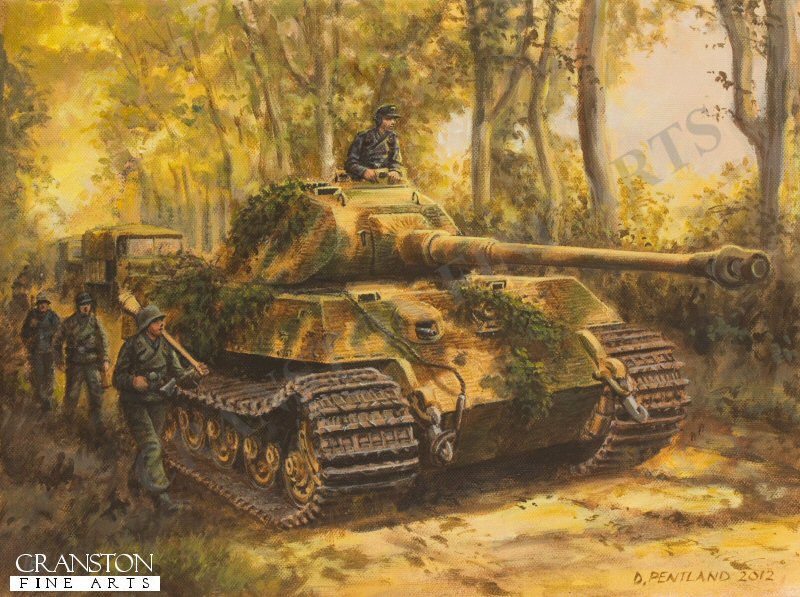
Kerscher's Defence of Neuhauser Forest by David Pentland. Oberfeldwebel Albert Kerscher, commander of 2nd company 511 Heavy Tank Battalion aided by a Panzer IV, two Hetzers, a Kingtiger and a Pak gun, successfully defended against concerted Soviet air and armoured attacks, his action buying valuable time for the evacuation of German wounded from Pilau and scoring his 100th victory in the process. |
Clash of Steel, Prokhorovka, Kursk, 12th July 1943 by David Pentland. The battle for Prokhorovka marked the high water mark of the German southern drive for Kursk. At the apex of the thrust were the 14 tiger tanks of the 13 Heavy Tank Company, 1st SS Panzer Division Liebstandarte, led by Michael Wittman. Their advance was eventually thwarted, however, by the epic charge of the Soviet 29th Guards Tank Corps, as part of 5th Guards Tank Armys furious counter attack against the SS Tank Corps. |
The Long Road to Kharkov by David Pentland. Kharkov, Russia, February - March 1943. After abandoning Rostov and Kharkov in the face of the Soviet Winter Offensive, Field Marshal Erich von Manstein set about the recapture of both. Among those taking part in the ensuing counterattack was the newly promoted tank gunner Ernst Barkmann, of 2nd Company 2nd SS Panzer Grenadier Division, who had just been given command of his own Panzer III. |
Rearm and Resupply by David Pentland. Albert Kerscher and Otto Carius. Kinderheim, Narva Bridgehead 17th March 1944, 2nd Kompany, 502 Heavy Tank Battalion. |
| Albert Kerscher Aircraft details |
| Albert Kerscher Squadron details |
|
Contact Details |
|
Sign Up To Our Newsletter!
This website is owned by Cranston Fine Arts. Torwood House, Torwoodhill Road, Rhu, Helensburgh, Scotland, G848LE Contact: Tel: (+44) (0) 1436 820269. Email: cranstonorders -at- outlook.com
|
|
|