|
|
|
|
|
 |
|
|
|
|
|
|
|
|
Spitfire Royal Air Force fighter aircraft, maximum speed for mark I Supermarine Spitfire, 362mph up to The Seafire 47 with a top speed of 452mph. maximum ceiling for Mk I 34,000feet up to 44,500 for the mark XIV. Maximum range for MK I 575 miles . up to 1475 miles for the Seafire 47. Armament for the various Marks of Spitfire. for MK I, and II . eight fixed .303 browning Machine guns, for MKs V-IX and XVI two 20mm Hispano cannons and four .303 browning machine guns. and on later Marks, six to eight Rockets under the wings or a maximum bomb load of 1,000 lbs. Designed by R J Mitchell, The proto type Spitfire first flew on the 5th March 1936. and entered service with the Royal Air Force in August 1938, with 19 squadron based and RAF Duxford. by the outbreak of World war two, there were twelve squadrons with a total of 187 spitfires, with another 83 in store. Between 1939 and 1945, a large variety of modifications and developments produced a variety of MK,s from I to XVI. The mark II came into service in late 1940, and in March 1941, the Mk,V came into service. To counter the Improvements in fighters of the Luftwaffe especially the FW190, the MK,XII was introduced with its Griffin engine. The Fleet Air Arm used the Mk,I and II and were named Seafires. By the end of production in 1948 a total of 20,351 spitfires had been made and 2408 Seafires. The most produced variant was the Spitfire Mark V, with a total of 6479 spitfires produced. The Royal Air Force kept Spitfires in front line use until April 1954. |
| David Pentland Spitfire Aviation Art Prints, Paintings and Drawings Aviation Art |
|
|
|
|
| Text for the above items : |
A Call to Arms by David Pentland. (P) Spitfires of No.603 Squadron, 23rd November 1940. The nearest aircraft is P7389 of Archie Winskill. |
The New Knights by David Pentland. (P) Spitfires of No.616 Squadron, September 1940. The aircraft nearest is K4330 QJ-G, the mount of Johnnie Johnson. |
Doe's Griffin by David Pentland. Portland, England, 30th September 1940. Already an accomplished Spitfire ace with at least 10 confirmed kills, Bob Doe had just transferred from 234 squadron to 238 Hurricane squadron when he intercepted and brought down a Heinkel He111P-2 from I/KG55 Griffin Geschwader. |
Spitfire! by David Pentland. Sussex Coast, England, 16th August 1940. For Donald MacDonald, Squadron leader of 64 Squadron, this particular day was fairly eventful. Catching the JG54 fighters and III/KG55 bombers on the coast, he personally accounted for one Me109E destroyed, another damaged, and a third probable. Continuing his attack he shared in the destruction of a He111P-2, and heavily damaged a second. |
| Spitfire Pilot and aircrew signature details |
  Air Commodore Peter Brothers CBE, DSO, DFC* Our estimated value of this signature : £65 Died : 2008 | Air Commodore Peter Brothers CBE, DSO, DFC* Learnt to fly at the age of 16 and joined the RAF two years later in 1936. He first saw action in 1940 when as a Flight Commander in 32 Squadron, based at Biggin Hill, he flew his Hurricane against the fighters and bombers of the Luftwaffe. He recalls this as an intensely busy period, during which he shot down an Me109 - his first enemy aircraft; by the end of August that same year his tally of enemy aircraft shot down increased to eight. Awarded the DFC, he was transferred to 257 Squadron where he joined Bob-Stanford Tuck as a Flight Commander. Promoted in 1941 to Squadron Leader, Pete Brothers then took command of 457 Squadron RAAF, equipped with Spitfires. A year later when 457 Squadron returned to Australia, Pete took command of 602 Squadron. In the early autumn of 1942 he went on to become Wing Leader of the Tangmere Wing, succeeding his old friend, Douglas Bader. By the end of the war Pete Brothers had amassed 875 operational hours over a 44-month period. He was credited with having personally shot down 16 enemy aircraft and damaged many more. He later went on to command 57 Squadron during the Malaya campaign. Upon return to the UK Pete Brothers joined the V-Force, flying Valiant-4 jet bombers. He retired in 1973. Sadly, Pete Brothers died 18th December 2008. |
Flight Lieutenant Roy Daines DFM Our estimated value of this signature : £50 | Flight Lieutenant Roy Daines DFM Roy Daines joined the RAF as soon as he was able, and after completing his hurried training as a pilot, was posted to join 247 Squadron in the autumn of 1940. Here he flew Gladiators and Hurricanes on coastal patrols, 247 being the only squadron to fly Gladiators during the Battle of Britain, before converting to nightfighting Hurricanes. Later, in 1943, he flew Typhoons with 247 before being posted to join 65 Squadron flying Spitfires and Mustangs. |
  Wing Commander Bob Doe, DSO, DFC* Our estimated value of this signature : £60 Died : 2010 | Wing Commander Bob Doe, DSO, DFC* In 1939 he joined the R.A.F. and upon completion of his training was posted to 234 squadron. During the Battle of Britain he achieved great success. He was one of the very few pilots to successfully fly both Hurricanes and Spitfires and was one of the top scorers of the Battle with 14 and two shared victories. He was awarded the DFC in October and a BAR in November. He joined 66 squadron as a Flight Commander then moving to 130 squadron in August 1943 saw him in 613 squadron flying Mustangs. October 1943 he was posted out to the Far-East, forming 10 squadron, Indian Air Force, which he led on the Burma front. Awarded the DSO in 1945. He stayed on in the R.A.F. after the war, retirement in 1966 was followed by opening a Garage business which proved successful. Sadly, we have learned of the passing of Bob Doe on 21st February 2010. |
  Group Captain Byron Duckenfield AFC Our estimated value of this signature : £50 Died : 2010 | Group Captain Byron Duckenfield AFC Byron Duckenfield started at Flying Training School on 25th November 1935 in a Blackburn B2 at Brough. As a Sergeant, he joined No.32 Sqn at Biggin Hill on 8th August 1936 and flew Gauntlets and Hurricanes. He joined 74 Squadron at Hornchurch on 11th April 1940, flying Spitfires, and on 5th May was posted to 501 Squadron flying Hurricanes at Tangmere. On the 11th of May at Betheniville, he survived a crash in a passenger transport Bombay aircraft in an aircraft in which he was a passenger, While comin ginto land the aircraft at 200 feet the aircraft stalled and the aircrfat fell backwards just levelly out as it histhe ground. 5 of th epassengers were killed when the centre section collapsed and crushed them. Duckenfield was fortunate as he had moved position during the flight. as the two passengers sitting each side of where he was sitting had died in the crash. (it was found later that the Bombay had beeb loaded with to much weight in the aft sectiion. ) recovering in hospital in Roehampton. On 23rd July 1940, he rejoined No.501 Sqn at Middle Wallop, then moved to to Gravesend two days later, scoring his first victory, a Ju87, on the 29th of July 1940. During August and September he scored three more victories. After a spell as a test pilot from 14th September 1940, he was posted to command 66 Squadron on 20th December 1941, flying Spitfires. On 26th February 1942 he took command of 615 Squadron flying Hurricanes from Fairwood Common, taking the squadron to the Far East. In late December 1942 he was shot down in Burma and captured by the Japanese. He remained a POW until release in May 1945. After a refresher course at the Flying Training School in November 1949, he took command of No.19 Squadron flying Hornets and Meteors from Chruch Fenton. After a series of staff positions, he retired from the RAF as a Group Captain on 28th May 1969. Duckenfield would write later his details : Burma At first light, 12 Hurricanes IIC aircraft of 615 Squadron, myself in the lead, took off from Chittagong for central Burma to attack the Japanese air base at Magwe, 300 miles away on the banks of the River Irrawaddy. Arriving at Yenangyaung, we turned downstream at minimum height for Magwe, 30 miles to the South and jettisoned drop tanks. Just before sighting the enemy base, the squadron climbed to 1200 feet and positioned to attack from up sun. On the ramp at the base, in front of the hangers, were 10 or 12 Nakajima KI - 43 Oscars in a rough line up (not dispersed) perhaps readying for take. These aircraft and the hangars behind them were attacked in a single pass, before withdrawing westward at low level and maximum speed. A few minutes later perhaps 20 miles away form Magwe, I was following the line of a cheung (small creek), height about 250 feet, speed aboput 280 mph, when the aircraft gave a violent shudder, accompanied by a very lound, unusual noise. The cause was instantly apparent: the airscrew has disappeared completely, leaving only the spinning hub. My immediate reaction was to throttle back fully and switch off to stop the violently overspeeding engine. Further action was obvious: I was committed to staying with the aircraft because, with a high initial speed, not enough height to eject could be gained without the help of an airscrew. So I jettisoned the canopy and acknowledged gratefully the fact that I was following a creek; the banks of either side were hillocky ground, hostile to a forced landing aircraft. Flying the course of the creek, I soon found the aircraft to be near the stall (luckily, a lower than normal figure without an airscrew) extended the flaps and touched down wheels-up with minimum impact ( I have done worse landings on a smooth runway!) My luck was holding, if one can talk of luck in such a situation. December is the height of the dry season in that area and the creek had little water, it was shallow and narrow at the point where I came down: shallow enough to support the fusalage and narrow enough to support wing tips. So I released the harness, pushed the IFF Destruct switch, climed out and walked the wing ashore, dryshod. The question may occur -Why did not others in the squadron see their leader go down? - the answer is simple, the usual tatctic of withdrawal from an enemy target was to fly single at high speed and low level on parallel courses until a safe distance from target was attained. Then, the formation would climb to re-assemble. Having left the aircraft, I now faced a formidable escape problem? I was 300 miles from friendly territory: my desired route would be westward but 80% of that 300 miles was covered by steep north-south ridges impenetrably clothed in virgin jungle; these were natural impediments, there was also the enemy to consider. Having thought over my predicament, I decided the best I could do - having heard reports of mean herted plainspeope - was to get as far into the hills as possible and then find a (hopefully sympathetic) village. I suppose I may have covered about 15 miles by nightfall when I came upon this small hill village and walked into the village square. Nobody seemed surprised to see me (I suspect I had been followed for some time) I wa given a quiet welcome, seated at a table in the open and given food. Then exhaustion took over, I fell asleep in the chair and woke later to find myself tied up in it. Next day I was handed over to a Japanese sergeant and escort who took me back to Magwe and, soon after that, 2.5 years captivity in Rangoon jail. Sadly we have learned that Byron Duckenfield passed away on 19th November 2010. |
 Flight Lieutenant Trevor Gray Our estimated value of this signature : £55 Died : 2012 | Flight Lieutenant Trevor Gray Trevor Gray joined the RAFVR in 1939 and was called for service on the outbreak of war. As he was only partially trained, he completed his flying training and after being awarded his wings was posted to 7 OTU at Hawarden After training Trevor Gray was commissioned as a Pilot Officer in August 1940. Converted onto Spitfires, and with the Battle of Britain at its Climax, he was urgently posted to join 64 Squadron at Leconfield, arriving on 16th September 1940. The Squadron had re-equipped from Blenheims to Spitfires earlier that year as it fought in the great air battles over Dunkirk, before seeing hectic action in the Battle of Britain. he damaged a Bf 110 in December 1940. He left the Squadron on April 3 1941 having completed his tour and was posted to 58 OTU at Grangemouth as an instructor from there he was posted to Castletown, the most northerly station on the mainland, to join 124 Squadron which was then being formed. Trevor Gray was then given a post as a research engineer officer at RAE Farnborough and finally left the RAF in 1946 as a flight Lieutenant. He died on 21st January 2012. |
  Flight Lieutenant Richard L Jones Our estimated value of this signature : £45 Died : 2012 | Flight Lieutenant Richard L Jones Richard Jones was born in 1918 and in July 1940 Richard Jones was posted to 64 Squadron at Kenley, flying Spitfires. He was involved in heavy fighting over the Channel during the Battle of Britain, with the squadron suffering many losses during July and August. Towards the end of the Battle of Britain, in October, he moved to 19 Squadron flying Spitfires from Fowlmere, and was heavily involved in the fighter sweeps taking place at that time. Near the end of the Battle of Britain, Pilot Officer Richard Jones was shot down during a dogfight over Kent with Me 109s. Jones crash landed his Spitfire in a field, colliding with a flock of sheep - he would go on to write in his log book 'Crashed into a load of sheep. What a bloody mess!' After the Battle of Britain, Richard Jones became a test pilot for De Havilland at Witney in Oxfordshire, and test flew thousands of Hawker Hurricanes and other types, including civil types. After the war Richard Jones joined the RAFVR and started a long career in the motor industry. Sadly Richard Jones passed away on 7th March 2012. |
 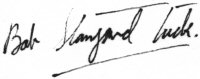 Wing Commander Bob Stanford Tuck DSO DFC** Our estimated value of this signature : £85 Died : 1987 | Wing Commander Bob Stanford Tuck DSO DFC** Bob Stanford Tuck was a flamboyant fighter pilot, his dashing good looks, courage, and success in the air coming to epitomise the young flyers who fought and won the Battle of Britain. To the British public he was a hero in the mould of the knights of old, and today his name is legend. In the early stages of the Battle of Britain Bob fought with 92 Squadron flying Spitfires, quickly becoming one of the leading aces. Promoted to command 257 Squadron, now flying Hurricanes, Bobs dashing style of leadership inspired his pilots to great success. He went on to command the Duxford and Biggin Hill Wings, taking his personal score to 29 air victories before being shot down by ground fire over Northern France in 1942. He died on 5th May 1987. |
  Wing Commander George W Swanwick Our estimated value of this signature : £50 Died : 2011 | Wing Commander George W Swanwick George Swanwick was born on 10th November 1915 and was an air-gunner on Wallaces and Hinds with 504 squadron at RAF Hucknall during the 1930s. In May 1936, 504 became part of the Auxiliary Air Force, and in October 1938 converted to a fighter unit, equipped with Gauntlets. In 1938 George re-trained as a pilot, and was promoted to Sergeant Pilot in August 1939. In May 1940 George Swanwick joined 7 BGS, and on 7th September was posted to 54 Squadron at Catterick flying Spitfires. He then went to 41 Squadron at Hornchurch. Commissioned in late 1941, he was posted to 222 Squadron at North Weald in April 1942 as a Flight Commander. In July George Swanwick joined 603 Squadron in Malta and in September 1942, George was posted to 7 OTU at Port Sudan as Flight Commander. In July 1943, he joined 81 Squadron in Malta as a supernumerary. George was invalided back to the UK and following his discharge from hospital in 1944, George held various staff appointments until the end of the war. George Swanwick was granted a Permament Commission in 1949 and retired on 30th April 1970, as a Wing Commander. Sadly, George Swanwick passed away on 4th January 2011. |
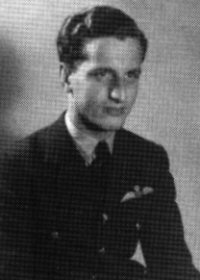  Flying Officer Kurt Taussig Our estimated value of this signature : £45 Died : 2019 | Flying Officer Kurt Taussig Czech Kurt was sent, age 15, by his parents on the Kindertrnsport to England from Czechoslovakia in June 1939 to escape the Nazi persecution of the Jews. Determined to fight the Germans he joined the RAF at eighteen in late 1942, and after training was posted to the Middle East to join 225 Squadron flying Spitfires on photo-reconnaissance duties in Tunisia, the Sicily landings, and in Italy. He died on 19th September 2019. |
| Spitfire Squadron details |
No.1 Sqn RAF Country : UK Known Codes : , JX, NA, | No.1 Sqn RAF In Omnibus Princeps - First in all things |
No.438 Sqn RCAF Country : Canada Disbanded 26th August 1945 Known Codes : , F3, | No.438 Sqn RCAF Wildcat Going down |
No.64 Sqn RAF Country : UK Disbanded 16th June 1967 Known Codes : , SH, GR, XQ, | No.64 Sqn RAF Tenax proposite - Firmness of purpose |
No.72 Sqn RAF Country : UK Disbanded 12th November 1981 Known Codes : , RN, SD, | No.72 Sqn RAF Basutoland Swift |
No.80 Sqn RAF Country : UK Disbanded 28th September 1960 Known Codes : , W2, AP, EY, GK, YK, | No.80 Sqn RAF Nil nobis obstare potest - Nothing can stop us |
|
Contact Details |
|
Sign Up To Our Newsletter!
This website is owned by Cranston Fine Arts. Torwood House, Torwoodhill Road, Rhu, Helensburgh, Scotland, G848LE Contact: Tel: (+44) (0) 1436 820269. Email: cranstonorders -at- outlook.com
|
|
|


