|
|
|
|
|
 |
|
|
|
|
|
|
|
|
|
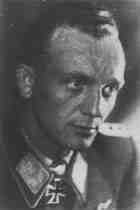
Joachim Brendel
Victories : 189
Joachim Brendel was born in April 27, 1921 in Ulrichshalben near Weimar. Brendel began his combat career in 1941 as a Leutnant and Rottenflieger with I./JG 51 on the Russian front. On only his fourth mission he scored his first victory, but had to wait until 31 March 1942 flying another 116 missions to score again. The beginning of 1943 saw a marked change in Brendels performance, by February he had 20 kills to his credit, on the July 9, 1943 he scored his 50th victory. After his 95th victory he was awarded the Knight's Cross of the Iron Cross and on the October 16, 1944 he achieved his 150th victory which earning him the Oak Leaves to the Knight' Cross on 14 January 1945 by this time his score stood at 156 kills. By now he had been promoted to the rank of Hauptmann and was Gruppenkommandeur of III./JG 51. His final victory came on the April 25, 1945. Joachim Brendel finished the War with 189 victories and emerged as JG 51 highest scorer on the Eastern Front, including over 90 heavily armored Ilyushin Sturmoviks. He died on July 7, 1974 in Cologne. |
  The Aircraft That Found the Bismarck by Ivan Berryman. |   Tribute to Generalleutnant Adolf Galland by Ivan Berryman. |   Tribute to Walter Briegleb by Ivan Berryman. |   The Hunted and the Hunter by Ivan Berryman. |
Joachim Brendel
| Squadrons for : Joachim Brendel | ||
| A list of all squadrons known to have been served with by Joachim Brendel. A profile page is available by clicking the squadron name. | ||
| Squadron | Info | |
Country : Germany Founded : August 1939 'Ace of Hearts' Click the name above to see prints featuring aircraft of JG51 | JG51 Jagdgeschwader 51 Mölders was a Luftwaffe fighter wing during World War II, named after the fighter ace Werner Mölders in 1942. JG 51's pilots won more Ritterkreuz des Eisernen Kreuzes than any other Jagdgeschwader, and flew combat from 1939 in all major theatres of war. Flying Bf 109s and then FW 190s, the wing claimed over 8,000 air victories. Experten included 'Toni' Hafner, Heinz Bär, Richard Leppla, Karl-Gottfried Nordmann, Günther Schack and the legendary Mölders. Formed in August 1939, and commanded by 48-year-old World War I ace Onkel Theo Osterkamp, the early months of the war JG 51 was based in the West, fighting in the French campaign, and in the Battle of Britain. From late June to mid July JG 51 was the only fighter Geschwader engaged against the RAF constantly. During the whole battle JG 51 lost 68 pilots, the highest casualty rate of the Luftwaffe fighter units engaged. JG 51 was one of the two Geschewader that had four Gruppen. The other being JG 1. Four Bf 109 of JG 51 in France 1940Whilst based out of the Belgian airfield at Mardyik in late 1940, the German ace Josef Pips Priller was a Staffelkapitän with JG 51, flying Bf 109-E Yellow One. Josef Priller went on to score over 100 victories, the third highest scoring Luftwaffe day fighter ace on the Western Front, fighting solely against the Western Allies. Against the Western Allies JG 51 had claimed 345 aircraft destroyed by May 1941. JG 51 were therefore one of the Jagdwaffe's elite units, with 'top ten' aces at this time including Werner Mölders with 68 claims, Walter Oesau with 34 claims, and Hermann-Friedrich Joppien with 31. Major Werner Mölders became unit Geschwaderkommodore during July 1940 and led the unit into the invasion of Russia in June 1941. Barbarossa (1941) Claiming 69 kills on the first day of the offensive, by 30 June 1941 JG 51 became the first fighter Geschwader to claim 1,000 air victories (113 kills in 157 sorties were claimed for the day). On 24 June JG 51 claimed 57 bombers shot down for the day. Mölders became the first fighter pilot to reach 100 claims in August and in the same month JG 51's Oberfeldwebel Heinz Bär reached 60 claims and was decorated with the Oak Leaves. A total of 500 Soviet claims was reached on 12 July 1941, although 6 pilots had been lost by JG 51 in the intervening 3 weeks since the offensive had started. After Mölders' departure in September 1941 (and death later that year) the Geschwader adopted his name as a title of honor in early 1942. Jagdgeschwader 51 Mölders was to remain on the centre sector of the Russian front throughout the rest of 1941. However Oberstleutnant Friedrich Beckh ( one of the few fighter pilots to wear spectacles) proved an uncharismatic commander after Mölders, and it was not until Major Karl-Gottfried Nordmann took over in April 1942 that a worthy successor to Mölders was found. In the period 22 June - 5 December 1941 the unit destroyed 1,881 Soviet aircraft, in return for 84 losses in aerial combat and a single aircraft on the ground. Air support for the Wehrmacht's Army Group Centre was entrusted to General Wolfram Freiherr von Richthofen's VIII. Fliegerkorps. In early January 1942, among the fighter units available to von Richthofen were II, III and IV/ JG 51. With the onset of the sub-zero conditions of the Russian winter, the majority of JG 51's available aircraft became grounded. The Russian winter counter offensive forced III./ JG 51 into flying numerous fighter-bomber operations in direct support of the infantry, and the gruppe filed few aerial 'kill' claims through January 1942. II./ JG 51 however, accounted for most of VIII. Fliegerkorps's aerial victories during the Soviet offensive. Particularly successful was the duo of Lt. Hans Strelow and Ofw. Wilhelm Mink, both of 5. JG 51. They claimed five MiG-3s of 16 IAP on 4 January (Mink claimed three) and 9 days later Mink claimed a Pe-2 and Strelow destroyed two R-Z biplanes for his 30th and 31st victories. On 4 February, Strelow increased his victories to 36 by shooting down four Russian aircraft. The 19 year-old Strelow claimed his 40th victory on 28 February and claimed 4 victories on both 6 March and 17 March. The next day he was awarded the Ritterkreuz des Eisernen Kreuzes and also shot down seven Soviet aircraft. He was awarded the Eichenlaub on 24 March, his claims total at 66. Normandy (1944) 7./JG 51, (with Bf 109G-6's) was attached to II./JG 1 in May 1944 from Brest-Litovsk, with pilots arriving at Störmede late in May and hurriedly converting to the FW-190. (It was later renamed 8./JG 1 on 15 August 1944 when the four-Staffeln Gruppe became standard) 7. Staffel was led by Ritterkreuzträger (Knight's Cross winner) Hptm. Karl-Heinz Weber with 136 confirmed kills. Its two other experten were Lt. Friedrich Krakowitzer (23 kills) and Ofhr. Günther Heckmann with 12 kills. 7./JG 51 joined II. Gruppe with 15 pilots on strength at the end of May, and during the first two months of the Normandy campaign the staffel was decimated, with twelve pilots killed, one POW and one severely wounded. As the war turned against Germany JG 51 was forced to operate closer and closer to Germany, finally staging out of East Prussia. | |