|
|
|
|
|
 |
|
|
|
|
|
|
|
|
Edward Crew
| Air Vice Marshal Edward Crew CB DSO DFC (deceased) Joining No 604 (County of Middlesex), an Auxiliary Air Force Squadron, in July 1940, Crew began to learn his trade as a night fighter pilot; among those with whom he flew at this time was John Cats' Eyes Cunningham, who himself became one of the most famous night fighter pilots of the war. It was a hard apprenticeship because Crew's Bristol Blenheim was equipped with early, and rudimentary, airborne radar, and much depended on the ability of his air gunner, Sgt Gus Guthrie, to adapt to his new calling as a radar operator. It was not until the following spring, when the squadron converted to two-engine Bristol Beaufighters, that the pair acquired a more suitable aircraft and sufficient expertise to dispatch five enemy bombers within a period of 10 weeks. This early run of success was speedily recognised with the award of the first of Crew's two DFCs. The citation stated: This officer is a pilot of outstanding ability who has shown tenacity of purpose to engage the enemy, which culminated in the destruction of two enemy aircraft in one night. Citations, by their very nature, are matter-of-fact, and do not capture the essence of their subjects. Others in the same squadron remembered Crew as a small, compact man who gave the impression of being larger than he was. He was seen as a patrician who hunted down his victims with a ferocity which was in marked contrast to his quietly spoken and always imperturbable manner. From the end of July 1941, Guthrie - Crew's eyes in combat - was posted away, and Crew was joined by Sgt Basil Duckett, with whom, in the spring of 1942, he achieved three further kills. Crew and Duckett made a brilliant team in which the radar operator's quiet persistence matched the pilot's natural hunting instincts. In early May 1942 Duckett enabled Crew to shoot down two Dornier 17 bombers on successive nights. Returning from the first of these encounters, over Portland in Dorset, Crew arrived back at base with the Dornier's trailing aerial wrapped around his Beaufighter's starboard propeller. Crew's second encounter developed into a long, drawn-out chase as he stalked the Dornier well out to sea off the Isle of Wight. As the enemy pilot twisted and turned to evade his pursuer, Crew refused to be shaken off, despite the fact that his guns were out of ammunition and Duckett was struggling to reload. Eventually, however, Crew's plane was able to deliver a burst which set the enemy bomber on fire and slowed it down as its gunner continued to return fire. At this point, the Beaufighter overshot the enemy aircraft, but Crew managed to keep it in view while Duckett again reloaded. Hunter and hunted continued to lose height until, at 2,000 ft, Crew saw the enemy crash into the sea, raising a plume of smoke and steam. Shortly afterwards Crew received a Bar to his DFC, the citation singling out his readiness to fly in all weather, his skill and ability in dealing with the enemy at night and his great example to the squadron. Edward Dixon Crew was born on December 24th 1917 at Higham Ferrers, Northamptonshire. He was brought up by his step-father, Sir Kenneth Murchison, a Tory MP, and educated at Felsted School and Downing College, Cambridge, where, in 1939, he joined the University Air Squadron. Following a sustained period of night operations with 604 Squadron, he was rested from October 1942 while commander of the Radio Development Flight; in March the following year he returned to operations in No 85, a Mosquito night fighter squadron. In June 1943 Wing Commander Crew received command of No 96 Squadron, leading its Mosquitoes against night raiders until the summer of 1944; this was when Hitler launched his so-called 'revenge weapons' against London and the South of England. Chasing pilotless V-1s - or 'chuff bombs', as Crew liked to call them - was by no means tame target practice. On June 25th he was on the tail of a V-1, travelling at high speed, when the force of the explosion as he shot it down split open his own aircraft's nose. Crew held the Mosquito steady long enough for his radar navigator, Warrant Officer W R Croysdill, to bail out over land. Then, as the Mosquito became uncontrollable, Crew himself jumped, landing safely near Worthing, in Sussex. Completing his Second World War operational career when 96 Squadron was disbanded in 1945, Crew was awarded the DSO. The citation emphasised his great skill in devising tactics to meet the menace of the flying bombs. That year he received a permanent commission and attended the RAF Staff College, before being posted in 1948 to command No 45 Beaufighter Squadron in the Far East. Operational once again, Crew led his squadron effectively against Communist insurgents aiming to destabilise Malaya. Harassing the jungle-based enemy in 100 night attacks, he consistently drove the terrorists into the hands of the security forces, for which he received a Bar to his DSO. The Air Ministry stated that Crew had displayed an almost uncanny knack in locating the target and attacking it on the first run in. From 1952 Crew served in Canada, where he commanded an operational training unit and introduced the Avro Canada CF100 all-weather fighter. After two years there he returned to command the all-weather development squadron at the Central Flying Establishment, with particular emphasis on trials of the Javelin. Later he commanded RAF Bruggen in Germany, before returning to the Far East in charge of the air task force in Borneo from 1965; his role here was dealing with the Indonesian Confrontation of the mid-1960s. Subsequently Crew commanded the Central Reconnaissance Establishment; he also served at the Ministry of Defence as Director of Operations (air defence and overseas), and was Deputy Air Controller of National Air Traffic Services. He retired as an air vice-marshal in 1973, when he joined the planning inspectorate of the Department of the Environment. Serving there until 1987, Crew was appointed CB in 1973 and elected a Fellow of the Royal Aeronautical Society in 1972. Air Vice Marshal Edward Crew CB DSO DFC died on the 18th August 2002 at the age of 84. |
Items Signed by Air Vice Marshal Edward Crew CB DSO DFC (deceased) |
  | Clipped Signature - Edward Crew. Price : £65.00 | With No.604 Sqn from July 1940, flew night missions on Blenheims and then Beaufighters, gaining a Distinguished Flying Cross for dispatching 5 bombers in just 10 weeks. He joined No.85 Sqn flying the Mosquito and took command of No.96 Sqn where he ...... | |
  | Height and Sun by Robert Taylor. (AP) SOLD OUT | If you had the height, you controlled the battle. If you came out of the sun, the enemy could not see you. If you held your fire until you were very close, you seldom missed. These three basic rules contributed to the prowess in aerial combat of som...... | NOT AVAILABLE |
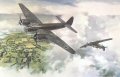  | Moment of Time by Geoff Nutkins Price : £120.00 | Squadron Leader Tom Gleave of No.253 Squadron attacking a Junkers Ju88 high above Shoreham, Kent on 31st August 1940. Signed by Group Captain T P Gleave, CBE Wing Commander A G Page, DSO, DFC & Bar Air Vice-Marshal E D Crew, CB...... |
Packs with at least one item featuring the signature of Air Vice Marshal Edward Crew CB DSO DFC (deceased) |
   | Wing Commander Bob Foster Signed Aviation Prints. Pack Price : £695.00 Saving : £310 | Aviation Print Pack. ...... Titles in this pack : Glorious Summer by Robert Taylor. (B) Spitfire F Mk21 by Ivan Berryman. (C) Hurricane Mk.IIC by Ivan Berryman. (F) |
| Air Vice Marshal Edward Crew CB DSO DFC Squadron details |
| Air Vice Marshal Edward Crew CB DSO DFC Aircraft details |
 Mosquito Manufacturer : De Havilland Built : 7781 | Mosquito Used as a night fighter, fighter bomber, bomber and Photo-reconnaissance, with a crew of two, Maximum speed was 425 mph, at 30,300 feet, 380mph at 17,000ft. and a ceiling of 36,000feet, maximum range 3,500 miles. the Mosquito was armed with four 20mm Hospano cannon in belly and four .303 inch browning machine guns in nose. Coastal strike aircraft had eight 3-inch Rockets under the wings, and one 57mm shell gun in belly. The Mossie at it was known made its first flight on 25th November 1940, and the mosquito made its first operational flight for the Royal Air Force as a reconnaissance unit based at Benson. In early 1942, a modified version (mark II) operated as a night fighter with 157 and 23 squadron's. In April 1943 the first De Haviland Mosquito saw service in the Far east and in 1944 The Mosquito was used at Coastal Command in its strike wings. Bomber Commands offensive against Germany saw many Mosquitos, used as photo Reconnaissance aircraft, Fighter Escorts, and Path Finders. The Mosquito stayed in service with the Royal Air Force until 1955. and a total of 7781 mosquito's were built. |
|
Contact Details |
|
Sign Up To Our Newsletter!
This website is owned by Cranston Fine Arts. Torwood House, Torwoodhill Road, Rhu, Helensburgh, Scotland, G848LE Contact: Tel: (+44) (0) 1436 820269. Email: cranstonorders -at- outlook.com
|
|
|


