|
|
|
|
|
 |
|
|
|
|
|
|
|
|
|
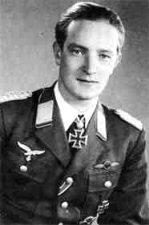
Friedrich-Karl Muller
Victories : 140
Oberstleutnant Friedrich-Karl “Tutti” Müller was born on 25 December 1916 at Berlin-Lichterfelde. At the outbreak of World War 2, Müller was serving with 8./JG 53. By the end of the French campaign, Leutnant Müller had accumulated eight victories, including his first, a French Curtiss Hawk 75 fighter, shot down on 27 May 1940. Müller participated in the Battle of Britain flying with the Stabsstaffel of III./JG 53. He added two RAF fighters to his tally during the aerial battles over England. Müller participated in the invasion of Russia and by the beginning of September 1941, had recorded his 20th victory, a Russian I-61 fighter shot down on 27 August. On 1 November, Müller was appointed Staffelkapitän of 1./JG 53. In spring 1942, Müller led 1./JG 53 to the Mediterranean theatre. Operating from bases in Sicily, Müller claimed three RAF Hurricane fighters shot down over Malta during this period to record his 22nd through 24th victories. In May 1942, I./JG 53 was relocated back to the Eastern front. Müller was particularly successful during this period. In August, Müller claimed 25 victories, including five enemy aircraft shot down on 12 August (47-51). In the period 1 to 19 September, Müller claimed 35 victories, including six Russia Il-2 Sturmovik ground-attack aircraft shot down on 9 September (78-83), five enemy aircraft on 17 September (88-92) and seven on 18 September (93-99). On 19 September, he claimed his 100th and 101st victories resulting in Oberleutnant Müller being awarded the Knight’s cross. He was awarded the Eichenlaub (Nr. 126) on 23 September. |
  The Aircraft That Found the Bismarck by Ivan Berryman. |   Tribute to Generalleutnant Adolf Galland by Ivan Berryman. |   Tribute to Walter Briegleb by Ivan Berryman. |   The Hunted and the Hunter by Ivan Berryman. |
Friedrich-Karl Muller
| Squadrons for : Friedrich-Karl Muller | ||
| A list of all squadrons known to have been served with by Friedrich-Karl Muller. A profile page is available by clicking the squadron name. | ||
| Squadron | Info | |
Country : Germany 'Ace of Hearts' Click the name above to see prints featuring aircraft of JG3 | JG3 Jagdgeschwader 3 (JG 3) Udet was a Luftwaffe fighter-wing of World War II. The Geschwader operated on all the German fronts in the European Theatre of World War II. It was named after Ernst Udet in 1942. Commanders of IV./JG 3 Major Franz Beyer, 1. June 1943 Hauptmann Heinz Lang , 11 February 1944 Major Friedrich-Karl Müller, 26 February 1944 Hauptmann Heinz Lang , 11 April 1944 Major Wilhelm Moritz, 18 April 1944 Hauptmann Hubert-York Weydenhammer, 5 December 1944 Major Erwin Bacsila, 5 January 1945 Oberleutnant Oskar Romm, 17 February 1945 Hauptmann Gerhard Koall, 25 April 1945 Hauptmann Günther Schack, 1 Mai 1945 | |
Country : Germany Founded : 1937 'Ace of Hearts' Click the name above to see prints featuring aircraft of JG53 | JG53 Pik-As was a Luftwaffe fighter-wing of World War II. It operated in Western Europe and in the Mediterranean. Jagdgeschwader 53 - or as it was better known, the Pik As (Ace of Spades) Geschwader - was one of the oldest German fighter units of World War II with its origins going back to 1937. JG53 flew the various models of Bf-109 throughout the second world war. | |
| Aircraft for : Friedrich-Karl Muller | |||
| A list of all aircraft associated with Friedrich-Karl Muller. A profile page including a list of all art prints for the aircraft is available by clicking the aircraft name. | |||
| Squadron | Info | ||

Manufacturer : Messerschmitt Production Began : 1937 Retired : 1945 Number Built : 33984 | Me109 Willy Messerschmitt designed the BF109 during the early 1930s. The Bf109 was one of the first all metal monocoque construction fighters with a closed canopy and retractable undercarriage. The engine of the Me109 was a V12 aero engine which was liquid-cooled. The Bf109 first saw operational service during the Spanish Civil War and flew to the end of World War II, during which time it was the backbone of the Luftwaffe fighter squadrons. During the Battle of Britian the Bf109 was used in the role of an escort fighter, a role for which it was not designed for, and it was also used as a fighter bomber. During the last days of May 1940 Robert Stanford-Tuck, the RAF ace, got the chance to fly an Me109 which they had rebuilt after it had crash landed. Stanford-Tuck found out that the Me109 was a wonderful little plane, it was slightly faster than the Spitfire, but lacked the Spitfire manoeuvrability. By testing the Me109, Tuck could put himself inside the Me109 when fighting them, knowing its weak and strong points. With the introduction of the improved Bf109F in the spring of 1941, the type again proved to be an effective fighter during the invasion of Yugoslavia and during the Battle of Crete and the invasion of Russia and it was used during the Siege of the Mediteranean island of Malta. The Bf109 was the main fighter for the Luftwaffe until 1942 when the Fw190 entered service and shared this position, and was partially replaced in Western Europe, but the Me109 continued to serve on the Eastern Front and during the defence of the Reich against the allied bombers. It was also used to good effect in the Mediterranean and North Africa in support of The Africa Korps. The Me109 was also supplied to several German allies, including Finland, Hungary, Romania, Bulgaria, Croatia, and Slovakia. The Bf109 scored more kills than any other fighter of any country during the war and was built in greater numbers with a total of over 31,000 aircraft being built. The Bf109 was flown by the three top German aces of the war war. Erich Hartmann with 352 victories, Gerhard Barkhorn with 301 victories and Gunther Rall with 275 kills. Bf109 pilots were credited with the destruction of 100 or more enemy aircraft. Thirteen Luftwaffe Aces scored more than 200 kills. Altogether this group of pilots were credited with a total of nearly 15,000 kills, of which the Messerschmitt Bf109 was credited with over 10,000 of these victories. The Bf109 was the most produced warplane during World War II, with 30,573 examples built during the war, and the most produced fighter aircraft in history, with a total of 33,984 units produced up to April 1945. Bf109s remained in foreign service for many years after World War II. The Swiss used their Bf109Gs well into the 1950s. The Finnish Air Force did not retire their Bf109Gs until March 1954. Romania used its Bf109s until 1955. The Spanish Hispanos flew even longer. Some were still in service in the late 1960s. | ||